
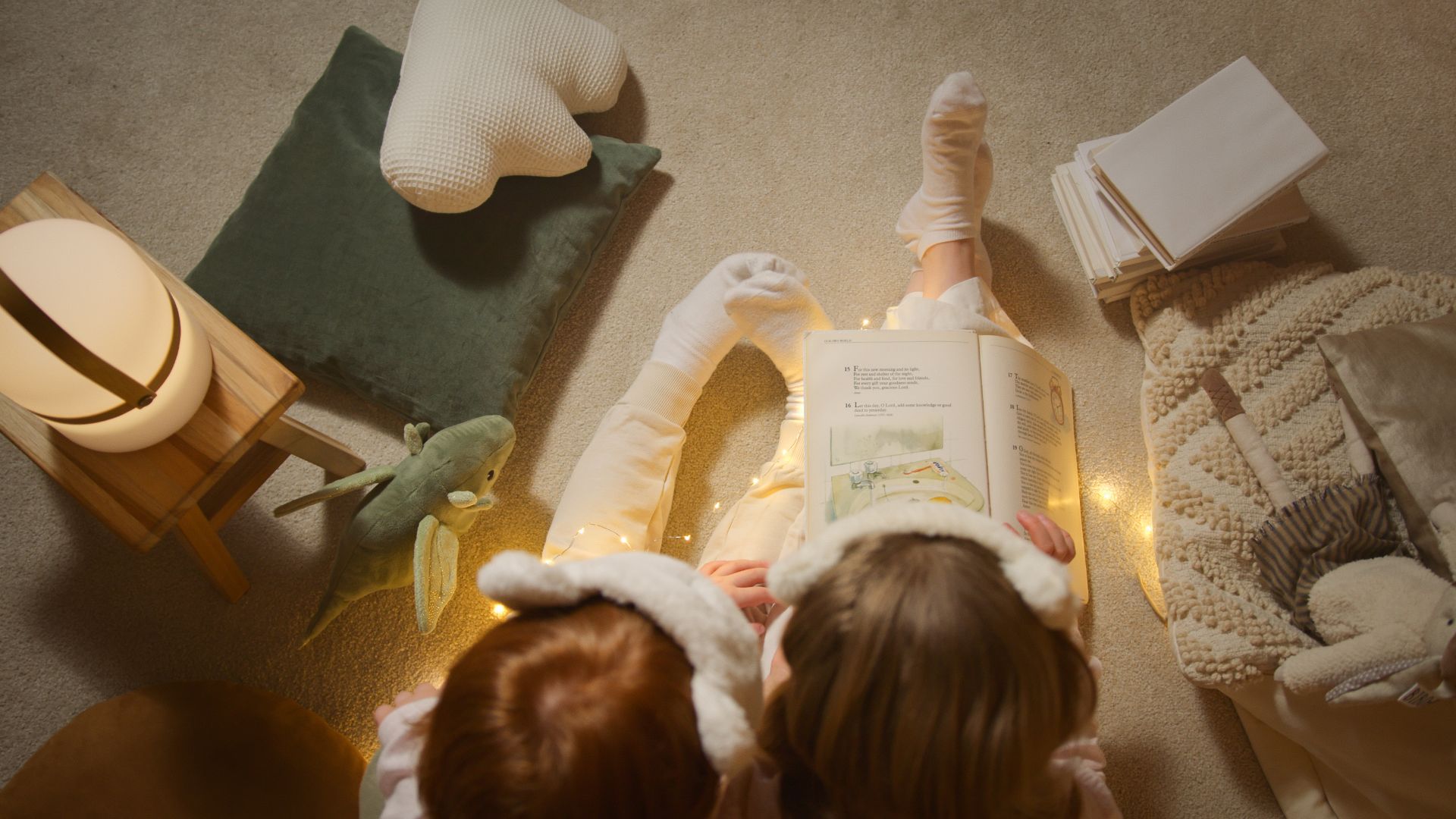

It’s just after dinner. The dishwasher hums, the kids are finally in pyjamas, and there’s a comfortable mess of soft toys and socks on the floor. We curl up on the couch, one child tucked under my arm, the other sprawled upside down with their feet on the backrest, and I open the book.
It’s one we’ve read twenty times before. The pages are bent, the corners soft from little fingers, the pages sticky, the words memorised. They giggle before the punchline even comes. And I read it the same way, voices and all, because that’s how they love it.
There’s no great lesson, no intentional literacy strategy. Just closeness. Language. Laughter. A shared rhythm between us that feels timeless and deeply human.
But somehow, in those ten minutes, something important is going on.
The house calms. The kids lean in. Their minds stretch in quiet ways. And I remember that this is what deep learning can feel like. Safe. Joyful. Bonded. Real.
It started with baby board books, gentle pastel stories of animals, nature, and bedtime rhyme. Stories with lullaby cadences that settled the soul. And it continues now, almost a decade later, with novels read aloud at night, filled with richly imagined worlds, stories of adventure, wonder and magic, and characters that feel alive.
Books like Where is the Green Sheep have lived inside our children for years. The rhythm and language of those early years have etched themselves into their inner worlds, like songs they’ll never forget. And now, Hogwarts and The Wild Robot deepen the roots of their imaginations and their literary lives.
Reading has always been part of our family culture. It’s an inherited rhythm, passed down through generations who understood that books are more than entertainment. They’re bonding, nourishment, and a portal to wonder and a shared vocabulary of meaning.
As Stephen King famously said in On Writing, “Books are uniquely portable magic.”
And we believe that. We’ve lived it.
What is lost?
But what saddens me is this: I’m seeing, increasingly, that this love-for the joy of reading aloud, of curling up with a story, of building a book-rich childhood, is vanishing in the youngest children I work with.
In the adult world, books are having a moment. BookTok is booming. Celebrity book clubs are everywhere. But for children, there’s a quieter crisis unfolding.
Fewer parents are reading to their kids. Fewer children are arriving at school having been bathed in language and stories. Screens have taken up the space where bedtime books once lived. The family rhythm has shifted, and stories are getting lost.
New research from HarperCollins UK and Nielsen BookData reveals that just 41% of parents now read regularly to their children under five, a steep decline from 64% in 2012. The generational divide is striking: while older parents are more likely to see reading aloud as a joyful ritual, nearly one in three Gen Z parents say they view it more as a school subject to be taught than an experience to be shared. Unsurprisingly, only a third of children aged 5–10 now read for pleasure frequently, down from more than half a decade ago. The family culture of reading aloud, once passed down like a treasured heirloom, is quietly slipping away.
We see the consequences in classrooms every day. Children are struggling with comprehension, vocabulary, attention, and even imagination. Not because they aren’t capable, but because they haven’t had enough of the foundational experience that story provides.
And when that experience is missing, something precious is lost, not just academically, but emotionally as well. Reading aloud isn’t only a literacy tool; it’s one of the deepest, richest pleasures of parenting. Families who skip it aren’t just risking lower literacy outcomes or slower school readiness. They’re missing out on bedtime magic, shared laughter, and the quiet intimacy that stories create. It’s a loss of connection, culture, and the kind of joy that lingers long after the book is closed.
This isn’t about guilt. It’s about possibility. The kind that starts quietly, with the turn of a page. Shared reading with children isn’t a performance or a parenting milestone. It’s a simple, daily invitation to connect, to slow down, and to share something meaningful. It doesn’t take much. Just a few minutes, a familiar story, a willing presence. And in that space, something deeper takes root. The joy is still there. And it’s ours to reclaim.
If you want to begin reading aloud – or begin again – here’s how:
☑ Pick a book you loved as a child. Joy is contagious.
☑ Let your child choose, even if it’s silly or simple. Repetition builds confidence.
☑ Make it part of bedtime again. Even five minutes matters.
☑ Try a read-aloud novel for older kids. They’re never too old to be read to.
☑ Turn off devices for that sacred time. Let story be the only screen.
☑ Visit the library. Make it a ritual. Show that books have value and variety.
Reading aloud won’t fix everything, but it reaches further than we often realise. It nurtures language, strengthens attachment, builds imagination, and creates a sense of calm and closeness that many families are quietly craving. More than that, it adds rhythm to the day and memory to the years. It reminds us, as parents, that we don’t have to do it all or have all the answers. We just need to show up, with a story in hand, and make it a habit worth keeping.